The Future of Metro / Rail Safety: AI, IoT and Connected Worker Technology
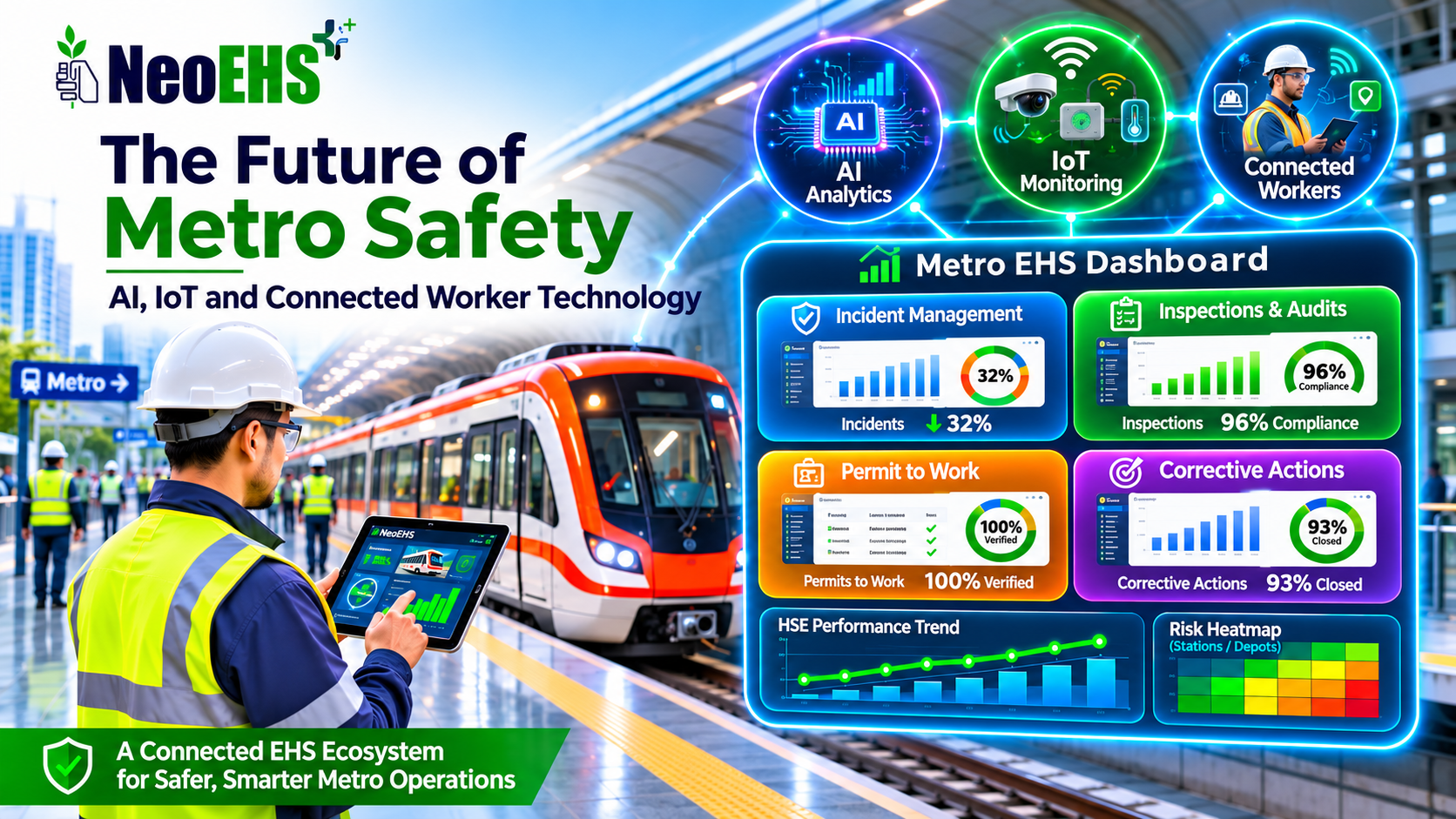
The future of metro safety is not about replacing people with technology. It is about giving people better information, earlier warnings and more effective ways to prevent harm.
What Are AI, IoT and Connected Worker Technologies in Metro Safety?
Three technologies are increasingly important to the digital transformation of metro safety.
Artificial Intelligence (AI) uses analytical models to identify patterns, classify information and support risk-based decisions. In metro safety, AI may assist with incident analysis, safety observations, computer vision and emerging-risk identification.
The Internet of Things (IoT) connects approved sensors, equipment and monitoring devices to information systems. Relevant applications include environmental monitoring, selected equipment conditions and infrastructure-related alerts.
Connected Worker Technology enables frontline personnel to access safety information, report hazards, complete inspections, review work instructions and communicate through authorized mobile or connected devices.
When appropriately integrated, these technologies can help metro organizations connect monitoring information with the people and processes responsible for acting on it.
1. Why Metro Safety Management Must Evolve
Metro networks are becoming more complex.
A single network may include underground stations, elevated corridors, depots, traction-power installations, maintenance workshops, passenger facilities and construction sites.
Safety responsibilities are distributed across many teams.
Station personnel monitor passenger environments.
Maintenance workers inspect equipment.
Contractors undertake construction and repair activities.
Supervisors manage permits and worksite controls.
HSE teams investigate incidents and track corrective actions.
When these activities are managed through disconnected systems, important information can be delayed or overlooked.
A serious inspection finding may remain unresolved in one department while another team prepares to work in the same area.
A contractor may have completed an induction but lack current authorization for a particular high-risk task.
An equipment warning may require a revised maintenance risk assessment, yet the relevant information may not reach the safety team promptly.
Digital transformation should address these operational gaps.
A connected metro safety system must bring together risk identification, field verification, communication, corrective action and management accountability.
2. AI-Powered Safety Intelligence: Recognizing Risk Patterns Earlier
Traditional safety reporting focuses heavily on incidents that have already occurred.
AI-assisted analytics can help organizations examine information from multiple sources to identify patterns that deserve preventive attention.
For example, suppose several metro depots report recurring maintenance-related near misses.
The incidents involve different workers and occur on different dates.
A conventional report may treat them as separate events.
A connected analytics system may help identify common factors such as similar equipment, incomplete isolation checks, repeated inspection findings or recurring work conditions.
Safety professionals can then investigate whether a wider control weakness exists.
Practical Applications of AI in Metro Safety
Incident intelligence: Analyze incident and near-miss records to identify recurring contributing factors.
Predictive risk analytics: Highlight combinations of conditions associated with elevated risk, subject to suitable data and validation.
Inspection analytics: Identify recurring deficiencies across stations, depots and contractors.
Corrective-action prioritization: Highlight overdue high-risk actions and repeated control failures.
Computer vision: Support detection of selected visible unsafe conditions using appropriately configured camera systems.
Safety reporting assistance: Help organize observations and relevant safety documentation.
AI is not a substitute for competent railway engineers, safety professionals or established operational controls.
Its value comes from helping those professionals identify meaningful information and act on it.
3. IoT: Making Metro Infrastructure More Visible
Metro operations depend on complex physical environments and equipment.
IoT technologies can provide additional information about selected operating conditions.
Tunnel and Underground Environmental Monitoring
Where justified by the risk assessment, connected sensors may monitor temperature, humidity, water levels, air quality or other relevant parameters.
Abnormal conditions can trigger alerts for investigation.
Electrical and Equipment Monitoring
Suitable condition-monitoring devices may identify unusual equipment temperatures or other relevant abnormalities.
This information can support maintenance planning and associated safety assessments.
Depot and Workshop Monitoring
Connected devices may help monitor selected machinery conditions and environmental hazards.
Flood and Water-Ingress Monitoring
Water-level monitoring can support early awareness of unusual conditions in vulnerable underground infrastructure.
Occupational Exposure Monitoring
Appropriate monitoring devices may help assess selected environmental exposures, provided they are technically suitable and maintained correctly.
However, sensor information is only useful when it is reliable and acted upon.
Calibration, alarm thresholds, connectivity, maintenance and response procedures are essential.
A sensor can identify an abnormal condition. Effective safety management determines what happens next.
4. Connected Workers: Bringing Digital Safety to the Point of Work
Metro safety is ultimately delivered by people working in real operational environments.
A maintenance engineer inspecting a tunnel cannot depend on an office-based spreadsheet for every safety decision.
A contractor working in a depot needs access to relevant permits, controls and procedures.
A station supervisor should be able to report a serious hazard without waiting until the end of a shift.
Connected worker technology supports these needs through authorized mobile applications and other suitable devices.
What Can Connected Metro Workers Do?
Depending on system configuration, workers may be able to:
-
Report hazards, unsafe conditions and near misses.
-
Complete digital inspections and checklists.
-
Access approved safety procedures.
-
Review relevant risk assessments.
-
View permit-to-work information.
-
Submit photographs and supporting evidence.
-
Receive safety notifications.
-
Update assigned corrective actions.
-
Confirm training or authorization information.
-
Access relevant emergency procedures.
Some applications also support offline data capture, which may be useful in underground locations with limited connectivity.
Offline reporting, however, must not be mistaken for reliable real-time emergency communication.
Safety-critical communications require separately assured systems and procedures.
The Real Value of Connected Workers
Connected technology should make it easier for workers to participate in safety management.
The goal is not to collect more personal information or monitor every movement.
It is to help workers recognize hazards, communicate concerns and receive timely responses.
5. Computer Vision: Supporting Safety Monitoring in Metro Environments
Metro networks already use CCTV for various security and operational purposes.
AI-enabled computer vision can potentially support additional safety monitoring.
Applications may include identifying selected PPE issues, restricted-area access, crowd congestion or unsafe conditions in defined work areas.
For example, an approved camera system at a depot may detect a person entering a designated restricted area.
The observation can be sent for appropriate review and response.
However, computer vision has limitations.
Poor lighting, obstructed views, unusual camera angles and model errors can produce false alarms or missed detections.
Deployments also require appropriate privacy safeguards, cybersecurity controls and data governance.
Computer vision should complement physical barriers, supervision and approved operating procedures.
6. Smart Permit to Work: Connecting Approval with Real Conditions
Metro maintenance and construction frequently involve high-risk work.
Examples include electrical isolation, track access, lifting operations, confined-space entry, hot work and work at height.
A traditional permit system documents authorization.
A connected digital permit system can additionally help link the authorization with risk assessments, responsible personnel, inspections and corrective actions.
Consider an overnight tunnel maintenance activity.
The permit has been approved and the initial controls verified.
During the work, a relevant environmental monitoring system identifies an abnormal condition.
Where properly integrated, that information can support an alert and reassessment of the activity.
The responsible personnel can then determine whether work must stop and what additional controls are required.
A digital permit does not make work safe by itself. Effective authorization depends on verified controls and continued assessment of changing conditions.
7. Connecting Predictive Maintenance with Safety Management
Metro organizations increasingly use condition monitoring and maintenance analytics.
These technologies can help identify equipment abnormalities and support maintenance planning.
But identifying a maintenance requirement is only part of the process.
The work needed to investigate or repair equipment can introduce additional risks.
For example, an abnormal equipment condition may lead to an inspection that requires electrical isolation, restricted access or work near operational infrastructure.
A connected approach can help relevant maintenance information inform the EHS risk assessment and work authorization process.
This creates a useful relationship between asset management and safety management.
The two systems should exchange appropriate information without compromising railway safety-critical controls.
8. Contractor Safety: One Network, Consistent Safety Expectations
Metro construction and maintenance often involve multiple specialist contractors.
Civil engineering teams, electrical contractors, signalling specialists, maintenance providers and infrastructure service organizations may operate simultaneously.
Managing these activities requires clear responsibilities and consistent controls.
Digital contractor safety workflows can support induction records, competency verification, risk assessments, inspections, incident reporting, permits and corrective-action tracking.
For example, before a contractor begins a high-risk maintenance activity, responsible personnel can review relevant training, authorization and permit requirements.
If an inspection identifies a serious deficiency, the finding can be assigned and tracked through an accountable process.
The objective is not simply to centralize records.
It is to strengthen coordination across organizations working within the same operational environment.
9. What Should a Modern Metro Safety Dashboard Measure?
A useful metro safety dashboard should answer operational questions.
Where are the most serious unresolved hazards?
Which critical controls have failed verification?
Which stations or depots have recurring inspection findings?
Are high-risk corrective actions being completed effectively?
Are contractors meeting competency and authorization requirements?
Recommended Metro Safety KPIs
| Safety Area | Suggested KPI |
|---|---|
| Critical risk management | Percentage of critical controls verified effective |
| Incident prevention | High-potential incident investigation quality |
| Maintenance safety | Permit and isolation verification compliance |
| Corrective actions | Overdue high-risk actions |
| Contractor safety | Competency and authorization compliance |
| Inspections | Serious findings and verified closure |
| Connected workers | Serious hazards reported and resolved |
| Environmental monitoring | Abnormal readings and response completion |
| Emergency preparedness | Drill findings and action completion |
| Management oversight | Unresolved high-risk issues by location |
The dashboard should support analysis by station, depot, corridor, contractor and reporting period.
It should also distinguish between routine administrative measures and indicators associated with serious harm.
For safety-critical failures, immediate operational response remains essential.
10. How NeoEHS Supports Connected Metro and Rail Safety
NeoEHS is an AI-powered Environment, Health and Safety management platform that supports connected safety workflows, risk management and operational visibility.
Its Metro & Rail Safety Management offering addresses safety requirements across railway environments.
Integrated Risk Management
NeoEHS helps organizations identify hazards, document risk assessments and manage preventive controls.
Digital Incident and Near-Miss Management
Incident workflows support reporting, investigation, corrective actions and safety learning.
Mobile Inspections and Audits
Digital inspections can help frontline teams record findings and assign follow-up actions.
Permit-to-Work Management
Structured workflows support high-risk work authorization and associated safety requirements.
Contractor and Competency Management
Connected records can support contractor oversight, training and authorization processes.
Corrective and Preventive Action Tracking
Responsible personnel can assign, monitor and verify actions arising from inspections, incidents and audits.
AI-Assisted Dashboards and Analytics
Management dashboards can bring together relevant safety information to support trend analysis and risk-based decisions.
IoT and CCTV Integration Opportunities
NeoEHS describes integration capabilities relevant to IoT, CCTV and enterprise systems.
Specific implementations depend on customer infrastructure, interfaces, cybersecurity requirements, configuration and validation.
From Disconnected Reports to Connected Decisions
Imagine a worker identifying an unsafe condition during depot maintenance.
The worker submits a digital observation.
The supervisor reviews the concern and assigns the necessary response.
The safety team can examine the finding alongside relevant risk assessments, inspections and previous incidents.
Management can monitor whether the corrective action has been completed and verified.
This is the practical value of connected EHS management.
NeoEHS supports the transition from isolated safety records toward more coordinated, informed and proactive safety workflows.
11. What Metro Organizations Must Get Right Before Deploying AI and IoT
Successful connected safety programs require more than software procurement.
Cybersecurity
Connected systems must use appropriate security controls and protect operational technology environments.
Data Quality
AI outputs depend on the quality, relevance and completeness of available information.
Connectivity
Underground environments may require specific communication arrangements.
Privacy
Connected worker applications should collect only necessary information and follow applicable privacy requirements.
Device Reliability
Monitoring devices need appropriate calibration, maintenance and validation.
Human Accountability
Qualified personnel must remain responsible for safety-critical decisions.
Workforce Adoption
Workers need clear procedures, training and confidence that reported concerns will receive appropriate attention.
Technology should simplify safe work—not create unnecessary administrative burdens.
12. A Practical Roadmap for Metro Safety Digital Transformation
Phase 1 — Digitize essential safety workflows.
Standardize incident reporting, inspections, risk assessments, permits, audits and corrective actions.
Phase 2 — Connect frontline personnel.
Introduce mobile reporting, field-accessible safety information and suitable notifications.
Phase 3 — Integrate relevant monitoring systems.
Evaluate approved IoT, CCTV, asset-management and enterprise integrations.
Phase 4 — Introduce AI-assisted analytics.
Identify recurring deficiencies, risk patterns and unresolved high-risk conditions.
Phase 5 — Build executive safety intelligence.
Provide relevant dashboards across stations, depots, contractors and maintenance activities.
Phase 6 — Measure effectiveness.
Review reporting timeliness, control effectiveness, corrective-action closure and worker participation.
Scale the approach after validating its operational value and safety assurance.
Conclusion: The Future of Metro Safety Is Connected—and Human-Centered
Metro networks will continue to expand.
Their infrastructure will become more sophisticated.
Their maintenance requirements will become more demanding.
And the volume of operational information will continue to grow.
But the central responsibility will remain the same: protecting passengers, workers, contractors and infrastructure.
AI can help identify patterns.
IoT can provide relevant monitoring information.
Connected worker technology can improve communication and field participation.
Digital EHS systems can connect these activities with accountable safety processes.
The greatest opportunity lies in bringing them together.
The future of metro safety will not be defined by the number of technologies deployed, but by how effectively those technologies help people prevent harm.
Explore NeoEHS for Metro & Rail
Learn how NeoEHS supports digital safety management, inspections, incident reporting, risk assessment, contractor oversight and connected EHS workflows.
Website: https://www.neoehs.com/
Metro & Rail Solutions: https://www.neoehs.com/industries/Metro-Rail-Safety-EHS-Management-Software
Email: info@neoehs.com
Metro & Rail Safety Management
metro rail EHS management software
AI-powered incident management
Inspection Management Software
digital metro safety inspections
digital permit-to-work management
AI-powered EHS platform
Q1. What is AI-powered metro safety?
AI-powered metro safety uses analytics, computer vision and connected EHS information to identify risk patterns, support investigations and help professionals make preventive safety decisions.
Q2. How can IoT improve metro safety?
IoT sensors can provide information about selected equipment and environmental conditions. When appropriately integrated, abnormal readings can support alerts, investigation and corrective action.
Q3. What is connected worker technology?
Connected worker technology gives frontline personnel access to digital inspections, hazard reporting, safety instructions, notifications and other authorized field information.
Q4. Can AI prevent metro accidents?
AI can support earlier recognition of risk, but it cannot guarantee accident prevention or replace engineering controls, operating rules, supervision or competent personnel.
Q5. Can connected worker applications operate in underground tunnels?
Some applications support offline data collection and later synchronization. Critical emergency communications still require appropriately assured communication systems.
Q6. Can NeoEHS integrate with CCTV and IoT?
NeoEHS describes CCTV, IoT and enterprise integration capabilities for Metro & Rail. Actual deployment depends on system compatibility, configuration, cybersecurity and operational requirements.
NeoEHS
Q7. Is NeoEHS a replacement for a railway Safety Management System?
No. NeoEHS can support safety management processes, but statutory railway safety obligations and safety-critical operational controls remain the responsibility of the railway organization.