Construction | Permit Approved, Accident Happens: What Goes Wrong With Construction PTW Systems?
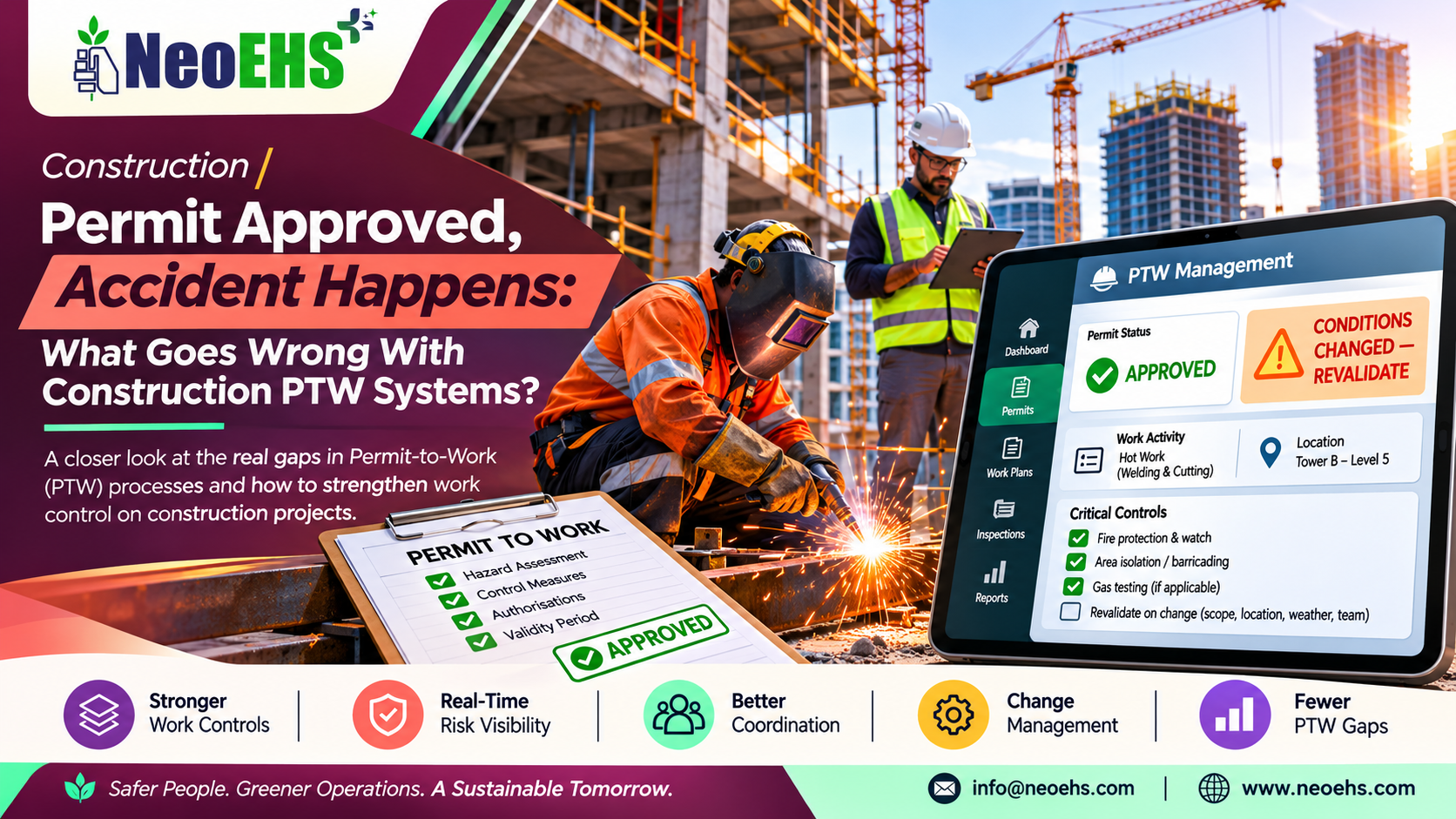
Why approved work permits can fail to prevent incidents—and how connected, AI-enabled EHS processes can strengthen construction safety.
A Permit-to-Work system is effective only when the controls established during authorisation remain valid throughout the work.
For construction companies managing multiple contractors, changing site conditions and overlapping activities, the distinction between permit approval and actual risk control is essential.
What Is a Construction Permit-to-Work System?
A construction Permit-to-Work (PTW) system is a formal control-of-work process used to authorise specified activities under defined conditions, responsibilities and safety precautions.
It typically identifies the work, location, hazards, required controls, authorised personnel, permit validity and arrangements for suspension, handover or closure.
Depending on the activity and applicable requirements, permits may be used for hot work, confined-space entry, excavation, electrical isolation, work at height and certain lifting or maintenance operations.
A PTW system does not make hazardous work safe simply by issuing permission.
It provides a structured mechanism for checking that work has been properly planned, relevant controls have been established and responsible personnel understand the conditions under which the activity may proceed.
Why Do Accidents Happen Even When a Work Permit Is Approved?
An accident can occur under an approved permit when hazards are missed, controls are ineffective, conditions change, contractors fail to coordinate, or workers continue after the original authorisation is no longer valid.
The problem is not necessarily the permit document itself.
It is often a breakdown between the information recorded during approval and the conditions encountered during execution.
1. Permit Approval Becomes an Administrative Exercise
On a busy construction project, supervisors may review numerous permit applications each morning.
When permit issuance becomes routine, the process can gradually shift toward checking whether forms are complete rather than verifying whether controls are effective.
A signed checklist may indicate that a control was considered.
It does not necessarily demonstrate that the control was correctly implemented.
For example, a permit may state that an excavation has been protected against collapse.
But if the excavation support is inadequate for the actual ground conditions, the permit has not eliminated the danger.
Permit approval should follow verification of critical precautions, not replace it.
2. Site Conditions Change After Approval
Construction sites rarely remain unchanged throughout a shift.
Rainfall can affect excavation stability.
Temporary access arrangements may be modified.
Lifting operations may introduce new exclusion zones.
Materials may be moved into an area where hot work is taking place.
A subcontractor may begin an activity that conflicts with another team's work.
These changes can invalidate assumptions made during the original risk assessment and permit review.
A mature PTW process must therefore define when work must stop, when reassessment is required and who has authority to approve revised arrangements.
3. Risk Assessments and Permits Are Disconnected
A Job Safety Analysis or task risk assessment may identify several critical controls.
However, the permit may reference only general precautions.
When the assessment and permit are managed separately, important information can be overlooked.
For example, a lifting risk assessment may require a particular exclusion zone, ground-bearing assessment and communication arrangement.
If the permit does not reference the applicable controls—or those controls are not verified at the worksite—the approval process may provide limited assurance.
Connecting permits with relevant risk assessments helps improve traceability.
4. Simultaneous Operations Are Not Properly Coordinated
Large construction projects involve many activities occurring at the same time.
These simultaneous operations, commonly called SIMOPS, can introduce hazards that are not apparent when individual permits are reviewed in isolation.
Consider a high-rise project where one contractor is conducting welding while another is applying a flammable coating nearby.
Each activity may have its own approved work documents.
But the interaction between them may create an unacceptable risk.
Effective permit coordination should consider work location, timing, adjacent activities and potential interference between contractors.
5. Critical Controls Are Not Verified in the Field
Some safety precautions are so important that their failure could directly contribute to a serious incident.
Examples include:
-
Verified electrical isolation before maintenance.
-
Suitable excavation support or protective systems.
-
Effective fall-prevention arrangements.
-
Appropriate atmosphere testing and rescue arrangements for confined-space entry.
-
Controlled lifting exclusion zones.
-
Adequate fire prevention and monitoring during hot work.
These controls require task-appropriate verification by competent personnel.
A digital checkbox, photograph or electronic signature can support the record, but it cannot independently establish that a control is technically adequate.
6. Permits Remain Active During Work Changes
A permit may have been issued for a defined activity, location, workforce and time period.
If the work scope changes, a new contractor arrives or equipment is replaced, the original authorisation may no longer be appropriate.
PTW procedures should establish clear rules for suspension, revalidation, handover and reissue.
A permit that remains electronically active should not be assumed to remain operationally valid.
7. Contractor Interfaces Are Poorly Managed
The permit issuer, work supervisor and contractor performing the activity may belong to different organisations.
Without clear communication, important information can be lost.
For example, the principal contractor may change a site access arrangement without informing a subcontractor whose permit depends on that access remaining controlled.
Contractor coordination must extend beyond initial authorisation.
8. Permit Closure Is Treated as a Form Submission
Permit closure should confirm that the activity has been completed or safely suspended and that the work area is left in an appropriate condition.
Depending on the work, this may involve removing equipment, accounting for personnel, reinstating safeguards, confirming isolation status and communicating handover requirements.
Premature closure or incomplete handover can expose subsequent workers to hazards.
Permit Approved vs Work Actually Safe: What Is the Difference?
| Permit approved | Work actually controlled |
|---|---|
| Required information has been reviewed | Hazards and precautions have been verified at the site |
| Authorised personnel have signed | Workers understand and follow the agreed controls |
| Permit validity is recorded | The permit remains appropriate to current conditions |
| Risk assessment is attached | Relevant controls are implemented and effective |
| Contractor is authorised | Interfaces with other activities are coordinated |
| Permit is marked closed | The work area has been checked and safely handed over |
The two are related, but they are not interchangeable.
A permit should provide evidence of a functioning control-of-work process—not merely proof that an approval was recorded.
Five Construction Activities Where PTW Failures Can Be Serious
Hot Work: When the Surrounding Environment Changes
Welding, cutting and grinding can create ignition sources.
A hot work permit may be appropriate where combustible materials, adjacent operations or other fire hazards require formal control.
A frequent challenge is ensuring that precautions remain effective when nearby work changes.
A robust process includes suitable fire prevention measures, coordination, monitoring and safe completion arrangements based on the work and applicable requirements.
Excavation: When Ground Conditions Are No Longer the Same
Excavation work can involve collapse hazards, buried services, vehicle movement and water accumulation.
A permit approved before rainfall or a change in excavation geometry may require reassessment.
Competent inspection and appropriate protective systems remain essential regardless of permit status.
Electrical Work: When Isolation Is Assumed Rather Than Verified
Electrical permits and isolation procedures may be used to control hazardous energy.
However, an approved document does not replace proper isolation, lockout arrangements where applicable, testing and verification by competent personnel.
The exact procedures depend on the installation, task and jurisdiction.
Confined-Space Entry: When Conditions Deteriorate
Confined-space work may involve hazardous atmospheres, restricted access and complex rescue requirements.
Permit controls may include atmospheric testing, isolation, ventilation, communication and rescue arrangements.
Conditions can change during entry, making monitoring and defined evacuation triggers essential.
Work at Height: When Temporary Protection Is Altered
Construction work at height may depend on scaffolding, edge protection, access systems and other preventive measures.
If temporary protection is removed or modified, the original work arrangement may no longer be safe.
Work should not continue simply because the permit remains valid on paper.
How Should a Construction PTW System Respond When Conditions Change?
A reliable control-of-work process should define what happens when a significant change is identified.
Step 1: Recognise the change. A worker or supervisor identifies a new hazard, changed work scope, altered site condition or conflicting activity.
Step 2: Stop or suspend affected work where necessary. Work should not continue where required controls are uncertain or ineffective.
Step 3: Reassess the risk. Competent personnel review the changed conditions and determine whether existing precautions remain adequate.
Step 4: Revise controls and authorisation. Update relevant assessments, permits and work arrangements as required.
Step 5: Communicate the change. Inform all affected workers, supervisors and contractors.
Step 6: Verify before restarting. Confirm that revised precautions are implemented and authorisation requirements have been met.
This process should be proportionate to the risk and aligned with the organisation's PTW procedure and applicable legislation.
How Digital Permit-to-Work Systems Can Improve Construction Safety
A digital PTW system can help reduce administrative fragmentation and improve visibility of work authorisations.
Its value comes from supporting a stronger control-of-work process.
Connected Permit Applications and Approvals
Digital workflows can organise permit requests, supporting documents, reviewer responsibilities and approval records.
This helps reduce reliance on disconnected paper forms and email chains.
Integration With Risk Assessments
Permits can be associated with task risk assessments, Job Safety Analyses and relevant work-control documentation.
This helps reviewers understand the controls associated with an activity.
Contractor and Work-Area Visibility
Where supported by the implementation, digital records can associate permits with contractors, supervisors, work locations and scheduled activities.
This can assist coordination and identification of potential SIMOPS conflicts.
Mobile Field Verification
Mobile tools can support site observations, photographs, checklists and confirmation records.
These features improve documentation but should complement—not replace—competent physical verification.
Permit Suspension and Revalidation
Structured workflows can support changes to permit status, reassessment records and renewed authorisation when conditions change.
The organisation must still define when revalidation is mandatory.
Corrective Action Integration
Where inspections identify deficiencies, connected corrective-action workflows can support assignment, follow-up and verification.
This improves the visibility of unresolved safety issues.
Management Dashboards
Dashboards can provide oversight of permit activity, outstanding approvals, suspended work and recurring deficiencies.
These indicators are most useful when interpreted alongside field conditions and operational context.
How AI Can Support Construction Permit-to-Work Management
AI can assist with information analysis and decision support, provided its limitations are understood.
Identifying Recurring Permit Deficiencies
AI-assisted analysis may help identify recurring problems in permit reviews, inspection findings and incident narratives.
Examples include repeated isolation deficiencies, inadequate work-area segregation or incomplete handover records.
Highlighting Potential Work Conflicts
When reliable information about locations, schedules and activities is available, analytical systems may help identify possible conflicts between work packages.
Such outputs require appropriate validation and supervisor review.
Supporting Permit Review
AI may help summarise relevant documentation or highlight missing information.
However, it should not independently certify that hazardous work is safe.
Analysing Near Misses and Incidents
Connecting incident information with permit records can help investigators explore whether work planning, coordination or control verification contributed to an event.
AI-generated insights should be treated as investigative leads, not definitive findings.
Prioritising Management Attention
Analytics may help safety teams identify areas with repeated permit deviations or unresolved critical findings.
A risk score should not substitute for the judgement of competent personnel.
AI should support permit decisions, not become an autonomous authority for safety-critical work.
What Should Construction Leaders See in a PTW Dashboard?
A useful dashboard should show more than the number of permits issued.
| Indicator | Why it matters |
|---|---|
| Active permits by location | Helps supervisors understand ongoing authorised activities |
| Permits awaiting approval | Identifies work requiring review |
| Suspended permits | Highlights activities requiring attention before restart |
| Permits requiring revalidation | Supports review following changes |
| Work-area conflicts | Helps coordinate simultaneous operations |
| Overdue permit closures | Identifies incomplete handovers |
| Repeated permit deficiencies | Reveals recurring process weaknesses |
| Critical-control verification status | Supports oversight of important precautions |
| Contractor permit trends | Helps target coordination and assurance activities |
These are recommended dashboard indicators, not a representation that every measure is available in every NeoEHS configuration.
How NeoEHS Supports Digital Construction Permit-to-Work
NeoEHS is an AI-powered Environment, Health and Safety management platform that supports connected EHS processes.
Relevant solution areas include:
Permit-to-Work Management: Structured permit requests, review, authorisation and work-control records.
Risk and Hazard Management: Documentation of hazards, assessments and preventive measures.
Contractor Management: Contractor-related safety information and coordination.
Digital Safety Inspections: Field observations, inspection records and follow-up activities.
Incident and Near-Miss Management: Reporting, investigation and identification of recurring weaknesses.
Corrective and Preventive Actions: Assignment, tracking and verification of improvement actions.
EHS Dashboards and Analytics: Management visibility of relevant safety information and trends.
For construction organisations, bringing these processes together can help reduce information gaps between permit approval, site execution and follow-up.
Specific features such as automated SIMOPS detection, real-time conflict alerts, geolocation controls or AI-generated recommendations should be confirmed against the deployed product configuration.
Explore NeoEHS Permit-to-Work Software and NeoEHS Construction Safety Solutions.
What Do Safety Standards Say About Permit-to-Work?
The UK Health and Safety Executive's guidance on Permit-to-Work systems emphasises that permits form part of a broader safe system of work.
ISO 45001 provides a framework for occupational health and safety management, including hazard identification, operational control, management of change and contractor-related activities.
International Labour Organization construction safety guidance also addresses planning, coordination and prevention of construction hazards.
Specific permit requirements vary between jurisdictions and activities.
Organisations should determine the applicable legal requirements and use competent personnel to design and implement their work-control procedures.
Construction PTW Effectiveness Checklist
Before relying on a permit, ask:
-
Is the work scope and location clearly defined?
-
Have relevant hazards been assessed?
-
Are critical controls identified and implemented?
-
Has the worksite been checked by competent personnel?
-
Are relevant risk assessments and procedures available?
-
Have affected contractors and supervisors coordinated?
-
Are conflicting simultaneous activities controlled?
-
Are required isolations and safeguards verified?
-
Do workers understand the permit conditions?
-
Are stop-work and suspension triggers clear?
-
Is there a defined process for changed conditions?
-
Are shift handover and revalidation arrangements adequate?
-
Are emergency arrangements appropriate?
-
Is permit closure supported by suitable checks?
-
Are recurring deficiencies reviewed and corrected?
Frequently Asked Questions
Can an accident happen even when a Permit-to-Work is approved?
Yes. A permit may have been approved correctly, but an incident can still occur if hazards change, precautions fail, workers deviate from the authorised activity or critical controls are not maintained.
What is the biggest weakness of construction PTW systems?
A major weakness is treating permit approval as proof of safety rather than maintaining an active process of hazard control, field verification, coordination and reassessment.
What is the difference between a PTW and a risk assessment?
A risk assessment identifies hazards, evaluates risks and establishes controls. A Permit-to-Work is a formal authorisation process for specified work under defined conditions. They serve different but complementary purposes.
When should a construction work permit be suspended?
A permit should be suspended or reassessed when changes or unsafe conditions invalidate its assumptions or controls, in accordance with the organisation's procedures and applicable requirements.
Can digital PTW software prevent accidents?
Digital PTW software can support better documentation, coordination and visibility. It cannot guarantee accident prevention or replace effective field controls.
How can AI improve Permit-to-Work management?
AI may assist with document analysis, recurring-deficiency detection and identification of potential work conflicts. Safety-critical decisions still require competent human oversight.
Should different subcontractors have separate permits?
Permit arrangements depend on the work, location, hazards and applicable procedures. Multiple contractors may require separate or coordinated authorisations to ensure responsibilities and interfaces are clear.
What is SIMOPS in construction Permit-to-Work?
SIMOPS refers to simultaneous operations that may affect one another. PTW coordination can help identify and control hazards created by overlapping activities.
Conclusion: A Signed Permit Is the Beginning of Control, Not the End
Construction projects operate in environments where conditions can change rapidly.
An approved permit records an authorisation decision made under particular assumptions and precautions.
It does not guarantee that those assumptions will remain valid.
Effective PTW management requires clear work planning, competent verification, contractor coordination, defined suspension triggers, reassessment and safe handover.
Digital systems can improve the visibility and traceability of these processes.
AI-assisted analytics may provide additional insights into recurring weaknesses and emerging patterns.
But the essential principle remains unchanged:
The objective is not to approve more permits. It is to ensure that hazardous work remains properly controlled from authorisation through completion.
Strengthen Construction Permit-to-Work Management With NeoEHS
Explore how NeoEHS supports digital work authorisation, risk management, contractor coordination, inspections, incident reporting and connected EHS intelligence.
Website: https://www.neoehs.com
Email: info@neoehs.com
NeoEHS — Safer People. Greener Operations. A Sustainable Tomorrow.